Hello everyone,
According to the WRF User Guide and various forum discussions, WRF can be initialized using either relative humidity (RH) or specific humidity (q) as atmospheric moisture input. The documentation generally states that both approaches are equivalent, since real.exe converts the input humidity fields into QVAPOR in wrfinput and wrfbdy.
However, during some recent tests I noticed that the two approaches lead to noticeable differences in the resulting simulations, even though the workflow technically works in both cases.
Finally, I suspect that even relatively small differences in humidity initialization could lead to systematic differences in long climate simulations (multi-year runs), especially through nonlinear processes such as cloud formation and precipitation.
I would be very interested to know whether others in the community have investigated this or observed similar differences.
Thank you very much for your support!
Best,
Marco
According to the WRF User Guide and various forum discussions, WRF can be initialized using either relative humidity (RH) or specific humidity (q) as atmospheric moisture input. The documentation generally states that both approaches are equivalent, since real.exe converts the input humidity fields into QVAPOR in wrfinput and wrfbdy.
However, during some recent tests I noticed that the two approaches lead to noticeable differences in the resulting simulations, even though the workflow technically works in both cases.
Experiment setup
- Model: WRF
- Domain: MED-CORDEX domain
- Resolution: 12 km
- Physics / namelist: standard MED-CORDEX configuration (already well tested)
- Simulation length: 1 month (January 2020)
- Output frequency: hourly
- Driving data: ERA5
Case 1 — Relative Humidity
- ERA5 RH (var157) used in WPS
- Default ECMWF Vtable (with RH)
- met_em files contain RH
- real.exe computes QVAPOR from RH
Case 2 — Specific Humidity
- ERA5 specific humidity (var133) used
- Vtable manually modified to replace RH with
133 | 100 | * | | SPECHUMD | kg kg-1 | Specific humidity - met_em files contain SPECHUMD
- real.exe computes QVAPOR directly from q
Result
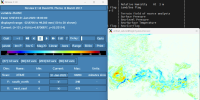
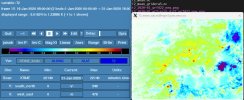
Despite this, the resulting simulations show systematic differences:- Monthly mean temperature differences generally < 0.5 K, but locally exceeding 1 K.
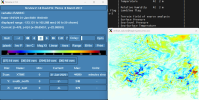
- Accumulated precipitation differs noticeably across several regions.
- Instantaneous differences in temperature and precipitation appear throughout the simulation.
- maps of temperature differences: case2(spechumd) - case1 (RH)
- maps of accumulated precipitation differences: case2(spechumd) - case1 (RH)
- namelist.input
- Vtable.ECMWF with SPECHUMD (case2) and Vtable with RH (default, case1)
Question
Since both workflows are described as equivalent in the documentation, I would like to ask:- Is it expected that using RH vs specific humidity as input leads to noticeable differences in WRF simulations?
- Is there a recommended best practice when driving WRF with ERA5 (prefer RH or specific humidity)?
- Could these differences arise from how interpolation and humidity conversion are performed in WPS/real.exe?
Finally, I suspect that even relatively small differences in humidity initialization could lead to systematic differences in long climate simulations (multi-year runs), especially through nonlinear processes such as cloud formation and precipitation.
I would be very interested to know whether others in the community have investigated this or observed similar differences.
Thank you very much for your support!
Best,
Marco