
I am currently conducting a typhoon simulation using GFS and OISST data. However, the initial storm intensity generated by real.exe is extremely weak. Therefore, I'd like to perform some quick optimization on the initial conditions.
Since I have no prior experience with data assimilation—which would likely require significant time and effort, so I plan to use tc_bogus to intensify the typhoon in the initial field, followed by DFI (Digital Filter Initialization) for smoothing.
Unfortunately, the results have been very unsatisfactory, suggesting I may have made mistakes in my procedure.
To help you understand my workflow, the steps I took as below:
For reference, I’ve attached my namelist.input, the rsl* log files from both the successful (dfi=0) and failed (dfi≠0) runs, and other potentially relevant files.
Additionally, I have another issue regarding tc_bogus: it does not seem to strengthen the typhoon as expected.
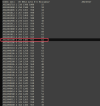
At 2022-08-31_00:00:00 UTC, the BST record shows a central pressure of 915 hPa.
I configured tc_bogus accordingly:
&tc
insert_bogus_storm = .true.
remove_storm = .false.
latc_loc = 25.9
lonc_loc = 130.3
vmax_meters_per_second = 62
rmax = 20000
vmax_ratio = 0.93
/
Without tc_bogus, my post-processing script gives:
(wrfpy310) dbw@sms:~/py310$ python cal_slp_min.py
Min SLP = 942.25 hPa
Latitude = 25.787
Longitude = 130.499
With tc_bogus applied, I get:
(wrfpy310) dbw@sms:~/py310$ python cal_slp_min.py
Min SLP = 950.68 hPa
Latitude = 26.004
Longitude = 130.385
Even after adjusting rmax and vmax_ratio, the simulated storm is consistently weaker than the case without tc_bogus.
In both cases (with or without tc_bogus), the minimum sea-level pressure is significantly higher than the observed BST value of 915 hPa.
Has anyone encountered similar issues or have suggestions on how to properly configure tc_bogus and DFI ? Any advice would be greatly appreciated.
thanks a lot
Since I have no prior experience with data assimilation—which would likely require significant time and effort, so I plan to use tc_bogus to intensify the typhoon in the initial field, followed by DFI (Digital Filter Initialization) for smoothing.
Unfortunately, the results have been very unsatisfactory, suggesting I may have made mistakes in my procedure.
To help you understand my workflow, the steps I took as below:
- I configured the tc_bogus section in namelist.input according to the best-track (BST) data and ran tc.exe, which generated auxinput1_d01_2022-08-31_00:00:00.nc.
- Following other forum threads, I replaced the variables {'RH','TT','UU','VV','GHT','PRES','PMSL','PSFC'} in the original met_em.d01.2022-08-31_00:00:00.nc file with those from auxinput1_d01_2022-08-31_00:00:00.nc.
- then i ran real.exe with sst_update = 1.
- I ran wrf.exe with DFI enabled. (I had to set sst_update = 0 in namelist.input for wrf.exe ,otherwise, it throws an error related to wrflowinp).
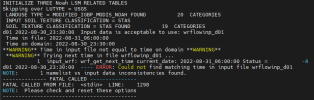
For reference, I’ve attached my namelist.input, the rsl* log files from both the successful (dfi=0) and failed (dfi≠0) runs, and other potentially relevant files.
Additionally, I have another issue regarding tc_bogus: it does not seem to strengthen the typhoon as expected.
At 2022-08-31_00:00:00 UTC, the BST record shows a central pressure of 915 hPa.
I configured tc_bogus accordingly:
&tc
insert_bogus_storm = .true.
remove_storm = .false.
latc_loc = 25.9
lonc_loc = 130.3
vmax_meters_per_second = 62
rmax = 20000
vmax_ratio = 0.93
/
Without tc_bogus, my post-processing script gives:
(wrfpy310) dbw@sms:~/py310$ python cal_slp_min.py
Min SLP = 942.25 hPa
Latitude = 25.787
Longitude = 130.499
With tc_bogus applied, I get:
(wrfpy310) dbw@sms:~/py310$ python cal_slp_min.py
Min SLP = 950.68 hPa
Latitude = 26.004
Longitude = 130.385
Even after adjusting rmax and vmax_ratio, the simulated storm is consistently weaker than the case without tc_bogus.
In both cases (with or without tc_bogus), the minimum sea-level pressure is significantly higher than the observed BST value of 915 hPa.
Has anyone encountered similar issues or have suggestions on how to properly configure tc_bogus and DFI ? Any advice would be greatly appreciated.
thanks a lot