
Hi everyone,
I am running a WRF simulation and encountering a persistent issue where the nighttime Relative Humidity (2m RH) is significantly underestimated compared to observations, while the 2m Temperature (T2) simulation is quite accurate.
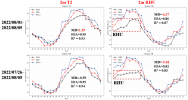
As shown in the attached figures (diurnal variation averaged over the simulation period), the model captures the T2 diurnal cycle well (MB = -0.59). However, there is a large negative bias in RH during the nighttime and early morning hours (MB = -5.18), where the model is much drier than the observations.
My Observations & Hypothesis:
I am running a WRF simulation and encountering a persistent issue where the nighttime Relative Humidity (2m RH) is significantly underestimated compared to observations, while the 2m Temperature (T2) simulation is quite accurate.
As shown in the attached figures (diurnal variation averaged over the simulation period), the model captures the T2 diurnal cycle well (MB = -0.59). However, there is a large negative bias in RH during the nighttime and early morning hours (MB = -5.18), where the model is much drier than the observations.
My Observations & Hypothesis:
- Temperature is not the cause: Since the nighttime T2 is very close to observations (or even slightly cooler), the low RH is not caused by the model being too warm.
- PBL Hypothesis: I suspect this might be related to the Planetary Boundary Layer (PBL) scheme. Could the model be simulating a nighttime PBL height that is too high, leading to excessive vertical mixing that dries out the surface layer?
- Is excessive vertical mixing/high PBL height a common cause for dry nighttime biases when T2 is accurate?
- Which parameters or namelist settings (e.g., related to vertical diffusion or minimum PBL height) would you recommend checking or adjusting to reduce this mixing at night?
- Are there other potential causes for this specific "dry night" bias I should investigate (e.g., land surface moisture)?
