
Hello,
I am not sure whether this is a basic question, but I would appreciate your guidance.
I ran a WRF simulation over the Phoenix area for one week (July 4, 2024, to July 10, 2024). When I attempted to validate the model against the airport observations (Figure 1 below), I found that the errors were extremely large. In fact, the model output and the observed data appear to belong to two entirely different time series, with almost no resemblance.
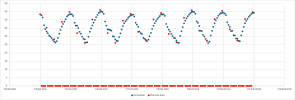
To investigate further, I checked the meteorological input (met_em) files for the innermost domain (1 km × 1 km) at Phoenix Airport location. When I compared the 2-meter temperature from the met_em files with the model results, they matched reasonably well (Figure 2 below). However, I am not sure whether I am checking the correct variables or interpreting the results properly.
What surprises me is that the WRF model output appears to agree well with the met_em files, which are based on CFSv2, but differs significantly from the airport observations used for validation. This raised the question of whether there could be a problem with the CFSv2 data.
Could someone please point out if I am making a mistake in my validation procedure or suggest possible reasons for such a large discrepancy? I would greatly appreciate any advice or guidance on the right direction to troubleshoot this issue.
Thank you very much for your time and help.
Figure 1 (validation against airport)- Phoenix local time
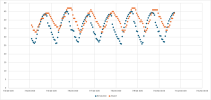
Figure 2 (comparison with met files with 6-hour data - in between values are 0 in the below figure) - UTC time
I am really confused about whether the incorrect results I am getting are due to the CFSv2 data I am using for the boundary conditions or because I have selected inappropriate physics options.
I would really appreciate it if anyone could share their thoughts or experiences.
Is it common for CFSv2 data to differ significantly from airport observations? Are there any other reliable sources of historical weather data that can be used instead of CFSv2? Or should I focus primarily on tuning the physics options to improve the simulation results?
I am not sure whether this is a basic question, but I would appreciate your guidance.
I ran a WRF simulation over the Phoenix area for one week (July 4, 2024, to July 10, 2024). When I attempted to validate the model against the airport observations (Figure 1 below), I found that the errors were extremely large. In fact, the model output and the observed data appear to belong to two entirely different time series, with almost no resemblance.
To investigate further, I checked the meteorological input (met_em) files for the innermost domain (1 km × 1 km) at Phoenix Airport location. When I compared the 2-meter temperature from the met_em files with the model results, they matched reasonably well (Figure 2 below). However, I am not sure whether I am checking the correct variables or interpreting the results properly.
What surprises me is that the WRF model output appears to agree well with the met_em files, which are based on CFSv2, but differs significantly from the airport observations used for validation. This raised the question of whether there could be a problem with the CFSv2 data.
Could someone please point out if I am making a mistake in my validation procedure or suggest possible reasons for such a large discrepancy? I would greatly appreciate any advice or guidance on the right direction to troubleshoot this issue.
Thank you very much for your time and help.
Figure 1 (validation against airport)- Phoenix local time
Figure 2 (comparison with met files with 6-hour data - in between values are 0 in the below figure) - UTC time
I am really confused about whether the incorrect results I am getting are due to the CFSv2 data I am using for the boundary conditions or because I have selected inappropriate physics options.
I would really appreciate it if anyone could share their thoughts or experiences.
Is it common for CFSv2 data to differ significantly from airport observations? Are there any other reliable sources of historical weather data that can be used instead of CFSv2? Or should I focus primarily on tuning the physics options to improve the simulation results?
Last edited: