
Hello all,
We are running MPAS-A 8.3.1 in limited-area mode over the northeast US/western Atlantic, initialized from the 2026-05-22 00Z GFS analysis. The limited area mesh was created from the 60km-15km mesh located in MPAS-Atmosphere mesh downloads and pictured at the end of this post. This post is a follow up to a previous forum post (scale_region strange behavior) where unexpected behaviour was observed using a scaled limited area mesh.
A mature extratropical cyclone (~984 hPa) was present over the northwest Atlantic at initialization (−48.75°W, 54°N). Within the first model hour, the cyclone fills by approximately 10–11 hPa and effectively disappears from its initial position. By t=6h the model shows a weaker system (~989 hPa) located ~450 km too far east relative to the GFS forecast at that time.
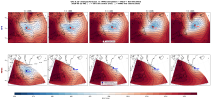
The MSLP tendency at the cyclone center between t=0 and t=1h reaches +16 hPa/hour. The u-wind tendency at 850 hPa shows ±7.5 m/s/hr near the low center. These values are consistent with a geostrophic/gravity-wave adjustment, which results in forecast errors in the area of interest (NE US). After significant testing we have determined that the same error does not appear when using a global, variable resolution mesh centered on the NEUS or the unscaled version of the variable resolution mesh, therefore it seems like the scaling of the limited area mesh is the cause.
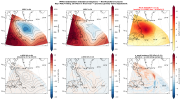
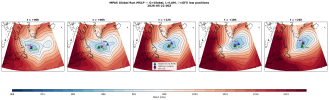
Based on the evidence we have collected, it seems that when you rescale/rotate an MPAS variable-resolution mesh to tightly focus on a specific region, the cell geometry may get distorted. Our best guess is that when MPAS ingests GFS pressure-level data onto these distorted cells, the hydrostatic and geostrophic balance conditions are no longer satisfied and the solver responds by violently redistributing mass, which results in the +10 hPa filling that is observed.
We are curious if this is a known issue with limited area meshes and if there are best practices to avoid this issue, or if we have misidentified what is going on. Any additional guidance from experienced MPAS-A limited area users would be greatly appreciated. Happy to share additional diagnostic plots.
Model version: MPAS-Atmosphere 8.3.1
Configuration: Limited-area, variable-resolution mesh (12–3 km, 480,676 cells), 55 vertical levels, convection_permitting physics suite (Thompson MP, MYNN PBL, Grell-Freitas CU)
ICs/BCs: GFS 0.25° analysis, 6-hourly LBC updates, config_nfglevels = 34
Problematic Grid Visualization: below and located in this google drive folder: mesh - Google Drive
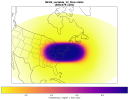
We are running MPAS-A 8.3.1 in limited-area mode over the northeast US/western Atlantic, initialized from the 2026-05-22 00Z GFS analysis. The limited area mesh was created from the 60km-15km mesh located in MPAS-Atmosphere mesh downloads and pictured at the end of this post. This post is a follow up to a previous forum post (scale_region strange behavior) where unexpected behaviour was observed using a scaled limited area mesh.
A mature extratropical cyclone (~984 hPa) was present over the northwest Atlantic at initialization (−48.75°W, 54°N). Within the first model hour, the cyclone fills by approximately 10–11 hPa and effectively disappears from its initial position. By t=6h the model shows a weaker system (~989 hPa) located ~450 km too far east relative to the GFS forecast at that time.
The MSLP tendency at the cyclone center between t=0 and t=1h reaches +16 hPa/hour. The u-wind tendency at 850 hPa shows ±7.5 m/s/hr near the low center. These values are consistent with a geostrophic/gravity-wave adjustment, which results in forecast errors in the area of interest (NE US). After significant testing we have determined that the same error does not appear when using a global, variable resolution mesh centered on the NEUS or the unscaled version of the variable resolution mesh, therefore it seems like the scaling of the limited area mesh is the cause.
Based on the evidence we have collected, it seems that when you rescale/rotate an MPAS variable-resolution mesh to tightly focus on a specific region, the cell geometry may get distorted. Our best guess is that when MPAS ingests GFS pressure-level data onto these distorted cells, the hydrostatic and geostrophic balance conditions are no longer satisfied and the solver responds by violently redistributing mass, which results in the +10 hPa filling that is observed.
We are curious if this is a known issue with limited area meshes and if there are best practices to avoid this issue, or if we have misidentified what is going on. Any additional guidance from experienced MPAS-A limited area users would be greatly appreciated. Happy to share additional diagnostic plots.
Model version: MPAS-Atmosphere 8.3.1
Configuration: Limited-area, variable-resolution mesh (12–3 km, 480,676 cells), 55 vertical levels, convection_permitting physics suite (Thompson MP, MYNN PBL, Grell-Freitas CU)
ICs/BCs: GFS 0.25° analysis, 6-hourly LBC updates, config_nfglevels = 34
Problematic Grid Visualization: below and located in this google drive folder: mesh - Google Drive