
Scheduled Downtime
On Friday 21 April 2023 @ 5pm MT, this website will be down for maintenance and expected to return online the morning of 24 April 2023 at the latest

WRF DFI setting for Twice DFI (TDFI)

JiaWang

New member
In the WRF guide, it states "dfi_cutoff_seconds = 3600 (should not be longer than the filter window)"
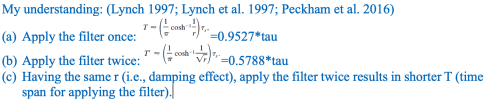
In the TDFI, WRF integrates backward from 0 to -2T, and then integrates forward from -T to T. Then what is the filter window, T or 2T?
In the Peckham et. al. (2016) paper, they set T=20min, and the cutoff frequency to be 1h. Do these numbers make sense given "should not be longer than the filter window"?
 
1764717314228.png
PS: in the above derivation, r~0.1.

If the "dfi_cutoff_seconds = 3600" which means tau=1h, then it will correspond to a minimum time span of 0.5788h (35min) in the case of TDFI.

Correction: Peckham et. al. (2016) set T=10min, which is equivalent to a time span of 20min.

I am not sure the effect of using a short time span (20min) that is smaller than the required minimum time span (35min).
 
Last edited:
1764720470405.png

My understanding is that, by using a time span less than the required minimum time span (T_minimum), it leads to less effective damping of high frequency waves
 
Hi, and apologies in the delay. I needed to correspond with a colleague who knew better about this. They , and this is their response:

The cutoff time defines the longest wave period the filter allows to pass, while the filter window represents the longest wave period this particular time series represents. Typically the filter window is chosen to be equal to the cutoff time. If they are different, it just means that the limit is not reached. If the paper by Peckham et. al presents reasonable results, it probably shows it is ok to use a smaller filter window and it supports this explanation, though we can't say definitively. Additional information and references can be found in the WRF Tech Note, which lists several papers by Lynch and Huang.

We will make a change to the Users Guide to reflect this, so as to not confuse others in the future.
 
Top
