Scheduled Downtime
On Friday 21 April 2023 @ 5pm MT, this website will be down for maintenance and expected to return online the morning of 24 April 2023 at the latest

Irrigation water volume is so different between full flood irrigation and 97% flood irrigation and 3% sprinkler irrigation

qingling

Member
Hi. I designed two different irrigation experiments in Xinjiang, China. The exp1 is full flood irrigation (100% flood irrigation fraction) and exp2 is 97% flood irrigation fraction and 3% sprinkler irrigation fraction. However, average irrigation water volume of exp1 is 617.82684 mm and average irrigation water volume of exp2 is only 252.82967 mm in the whole year. I don't know why there is such a big difference between these two values?

 
Hello Qingling, Can you provide some more details about your experiments and the model output you are looking at?

How do you change the irrigation fraction in your experiment setup? The related variable names in the geo_em and wrf input file would be: IRFRACT (total irrigation fraction), SIFRACT, FIFRACT, MIFRACT (irrigation fractions by three methods). So far the latter three variables are obtained from USDA at county level in the US.

For irrigation amounts from WRF model output, one thing to quickly check would be: IRSIVOL, IRFIVOL, IRMIVOL
These are the accumulated irrigation amount output from the beginning of simulation for three specific irrigation methods (sprinkler, flood, and micro drip).

Also, what are the namelist options you used for WRF/NoahMP section?

Many thanks,
Zhe
 
Hello Qingling, Can you provide some more details about your experiments and the model output you are looking at?

How do you change the irrigation fraction in your experiment setup? The related variable names in the geo_em and wrf input file would be: IRFRACT (total irrigation fraction), SIFRACT, FIFRACT, MIFRACT (irrigation fractions by three methods). So far the latter three variables are obtained from USDA at county level in the US.

For irrigation amounts from WRF model output, one thing to quickly check would be: IRSIVOL, IRFIVOL, IRMIVOL
These are the accumulated irrigation amount output from the beginning of simulation for three specific irrigation methods (sprinkler, flood, and micro drip).

Also, what are the namelist options you used for WRF/NoahMP section?

Many thanks,
Zhe
Thank you for your reply.
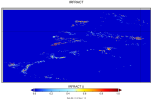
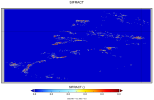
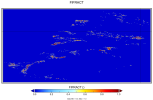
1. SIFRACT, FIFRACT, MIFRACT and IRFRACT have the same spatial distribution.
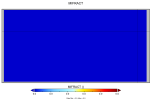
2. exp1 (100% flood irrigation fraction) : FIFRACT is set 1 at all grids and SIFRACT and MIFRACT are set 0 at all grids. exp2 (97% flood irrigation fraction and 3% sprinkler irrigation fraction): FIFRACT is set 0.97, SIFRACT is set 0.03, and MIFRACT is set 0 at all grids. exp1 and exp2 are ideal experiments. Figures of IRFRACT,SIFRACT, FIFRACT and MIFRACT have been attached from exp2.

1763688723461.png1763688806907.png
1763688882593.png1763688947625.png
3. exp1: IRSIVOL + IRFIVOL + IRMIVOL = 0+ 617.82684 + 0 = 617.82684 mm (average value of all irrigated grids in one year). exp2: IRSIVOL + IRFIVOL + IRMIVOL = 31.8 + 221.02967 + 0 = 252.82967 mm (average value of all irrigated grids in one year). Then, I fund that IRNUMFI (321) in exp1 is much larger than IRNUMFI (38) in exp2. I think numbers of triggered irrigation is a key reason about that issue. But I don't find logical error about irrigation codes in the module_sf_noahmplsm.F after I checked carefully. This is confusing.
4. namelist.input have been attached.

Thank you very much!!!
 

Attachments

  • namelist.input
    5.9 KB · Views: 0
Top