Hi everyone,
I am currently running MPAS-A v8.3.1 for a 2-year global run using ERA5 as the Initial Condition. I downloaded ERA5 (from the Copernicus CDS) in GRIB format and used WPS to make the intermediate files. For SST and sea-ice, I am using the same ERA5 dataset (in NetCDF format) 6-hourly and created the intermediates using the pywinter Python package.
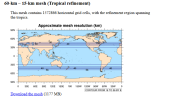
This is my first attempt using this IC and lower boundary condition setup for a variable resolution mesh (15km tropical refinement: x4.1572866.grid.nc). This exact same methodology, with the same IC and LBC sources, worked perfectly well for a long-term run on a 120km quasi-uniform mesh.
These are the steps I followed:
global min, max w NaN NaN
global min, max u NaN NaN
Because the atmosphere instantly generates NaN air temperatures and winds, it passes these down to the Land Surface Model. Noah-MP (running with config_noahmp_iopt_dveg = 1 (tried with 4 as well, the default)) before halting:
STOP Error: Longwave radiation budget problem in NoahMP LSM
STOP
emitted longwave <0; skin T may be wrong due to inconsistent
input of VegFracGreen with LeafAreaIndex
(Note: I checked init.nc with ncdump and there are no NaNs in the initial fields like theta or w, so the initialization file itself is not corrupted. The NaNs are generated dynamically right at startup).
Could somebody from the team help me with this ? I even tried with NOAH as LSM, it still failed. Any help would be appreciated. Thanks very much.
I am currently running MPAS-A v8.3.1 for a 2-year global run using ERA5 as the Initial Condition. I downloaded ERA5 (from the Copernicus CDS) in GRIB format and used WPS to make the intermediate files. For SST and sea-ice, I am using the same ERA5 dataset (in NetCDF format) 6-hourly and created the intermediates using the pywinter Python package.
This is my first attempt using this IC and lower boundary condition setup for a variable resolution mesh (15km tropical refinement: x4.1572866.grid.nc). This exact same methodology, with the same IC and LBC sources, worked perfectly well for a long-term run on a 120km quasi-uniform mesh.
These are the steps I followed:
- Made the static file using the downloaded static terrestrial data, modified config_geog_path, and successfully created the static file.
- Created the init file with the right prefix, and similarly created the lower boundary update file (SST).
- Ran the atmosphere_model.
global min, max w NaN NaN
global min, max u NaN NaN
Because the atmosphere instantly generates NaN air temperatures and winds, it passes these down to the Land Surface Model. Noah-MP (running with config_noahmp_iopt_dveg = 1 (tried with 4 as well, the default)) before halting:
STOP Error: Longwave radiation budget problem in NoahMP LSM
STOP
emitted longwave <0; skin T may be wrong due to inconsistent
input of VegFracGreen with LeafAreaIndex
(Note: I checked init.nc with ncdump and there are no NaNs in the initial fields like theta or w, so the initialization file itself is not corrupted. The NaNs are generated dynamically right at startup).
Could somebody from the team help me with this ? I even tried with NOAH as LSM, it still failed. Any help would be appreciated. Thanks very much.
 and pressure information (PRES