Dear MPAS developers and users,
I am running MPAS-Atmosphere [v7.1] to simulate a [heavy snowfall event], and I would like to diagnose the cloud microphysics budgets of cloud ice, snow, and graupel in detail — for example, the separate contributions from deposition/sublimation, riming, freezing, and melting, similar to the microphysical budget analysis in Ko et al. (2022, GMD). I have been using config_microp_scheme = 'mp_thompson' (and I would also like to do the same with 'mp_wsm6').
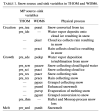
So far, I have found the following fields in the Registry, which give the net tendency for each hydrometeor species:
From reading the source code, I understand that these process rates are already computed internally in module_mp_thompson.F (e.g., prs_sde, prg_gde, prs_scw, prg_gcw, ...) and in module_mp_wsm6.F, but they are local variables and are not written to the model output.
Could you please advise:
Thank you very much for your time.
Best regards
I am running MPAS-Atmosphere [v7.1] to simulate a [heavy snowfall event], and I would like to diagnose the cloud microphysics budgets of cloud ice, snow, and graupel in detail — for example, the separate contributions from deposition/sublimation, riming, freezing, and melting, similar to the microphysical budget analysis in Ko et al. (2022, GMD). I have been using config_microp_scheme = 'mp_thompson' (and I would also like to do the same with 'mp_wsm6').
So far, I have found the following fields in the Registry, which give the net tendency for each hydrometeor species:
- rqimpten, rqsmpten, rqgmpten (tendency of cloud ice/snow/graupel mixing ratio due to cloud microphysics)
- rthmpten (potential temperature tendency)
- rnimpten, rnrmpten (number concentration tendencies, Thompson only)
From reading the source code, I understand that these process rates are already computed internally in module_mp_thompson.F (e.g., prs_sde, prg_gde, prs_scw, prg_gcw, ...) and in module_mp_wsm6.F, but they are local variables and are not written to the model output.
Could you please advise:
- Is there any existing option in MPAS-Atmosphere (namelist, stream field, or compile flag) to output these individual microphysical process rates, or has anyone already implemented such a diagnostic?
- If not, what would be the recommended (minimal) way to add them? My current plan is to modify the Registry, the microphysics scheme module, the microphysics driver, and the stream file — is that the right approach, and are there any pitfalls to be aware of (e.g., the sub-stepping of the microphysics call)?
Thank you very much for your time.
Best regards