Dear all,
I would like to ask for your advice regarding the snow initialization in my WRF/Noah-MP simulation.
I am using ERA5 as the meteorological forcing for my simulation. However, I found that ERA5 considerably overestimates the snow cover over my study area. For this reason, I used MODIS snow-cover observations to correct the initial snow conditions in the wrfinput files.
Following an elevation-based approach, I defined a snowline/baseline from MODIS and applied a gradual transition with elevation. Based on this, I modified the initial snow-cover field together with the related snow variables, including snow depth and snow water equivalent, so that the initial snow distribution became much closer to the MODIS observations.
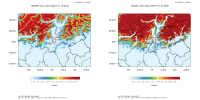
At the initial model time, the corrected snow field looks reasonable and agrees quite well with MODIS. However, after the simulation starts, I see a very rapid increase in SNOWC. Already after about one hour, many grid cells reach values close to 1, although the changes in snow depth, SWE and the other snow-related variables are comparatively much smaller.
I understand that snow cover should naturally evolve during the simulation, but this increase in SNOWC seems too large and too rapid compared with the changes in the actual snow state.
Could you please advise me on how I should handle this? In particular, how can I initialize the snow variables so that the MODIS-based snow distribution remains physically consistent with Noah-MP after the model starts? Would it be appropriate to investigate the Noah-MP snow-cover formulation or parameters such as SCFFAC and MFSNO, or would you recommend a different approach?
My main concern is to avoid this unrealistic increase in SNOWC while still using the MODIS observations to obtain a realistic initial snow distribution.
Kind regards,
I would like to ask for your advice regarding the snow initialization in my WRF/Noah-MP simulation.
I am using ERA5 as the meteorological forcing for my simulation. However, I found that ERA5 considerably overestimates the snow cover over my study area. For this reason, I used MODIS snow-cover observations to correct the initial snow conditions in the wrfinput files.
Following an elevation-based approach, I defined a snowline/baseline from MODIS and applied a gradual transition with elevation. Based on this, I modified the initial snow-cover field together with the related snow variables, including snow depth and snow water equivalent, so that the initial snow distribution became much closer to the MODIS observations.
At the initial model time, the corrected snow field looks reasonable and agrees quite well with MODIS. However, after the simulation starts, I see a very rapid increase in SNOWC. Already after about one hour, many grid cells reach values close to 1, although the changes in snow depth, SWE and the other snow-related variables are comparatively much smaller.
I understand that snow cover should naturally evolve during the simulation, but this increase in SNOWC seems too large and too rapid compared with the changes in the actual snow state.
Could you please advise me on how I should handle this? In particular, how can I initialize the snow variables so that the MODIS-based snow distribution remains physically consistent with Noah-MP after the model starts? Would it be appropriate to investigate the Noah-MP snow-cover formulation or parameters such as SCFFAC and MFSNO, or would you recommend a different approach?
My main concern is to avoid this unrealistic increase in SNOWC while still using the MODIS observations to obtain a realistic initial snow distribution.
Kind regards,