Scheduled Downtime
On Friday 21 April 2023 @ 5pm MT, this website will be down for maintenance and expected to return online the morning of 24 April 2023 at the latest

Time shift in wind speed and direction in long-term NDOWN downscaling simulation

Arty

Member
Hello WRF Community,

I observed a time shift in wind speed and direction while running a 25-year climate simulation (1991–2016) using NDOWN downscaling from a 21-km parent simulation to a double-nest, 2-way simulation with resolutions of 7 km (d01) and 2.3 km (d02).

During my test runs (3-year runs starting September 2013) with multiple configurations, I did not observe such shifts. In those tests, wind direction and magnitude were coherent with observations. It seems that the shifts appear only over very long simulations.

For my long-term simulation, I used the initial wrfinput* file generated by NDOWN, starting 1991-02. I am now a bit desperate because these are very long and computationally intensive runs. Initially, I regularly checked my outputs for the first decade, and as all seemed normal, I let the runs continue.

I am unsure what could have caused this. Should I have used monthly NDOWN-generated wrfinput files to re-initialize the runs correctly? This seems contradictory to the idea of letting the simulation run after spin-up.

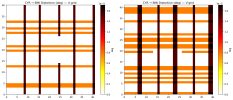
I have attached a couple of figures for d02 (90x90 grid cells, 2.3-km resolution, centered on Tahiti, 17.5°S, 149.5°W) :
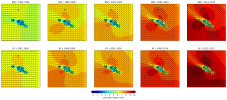
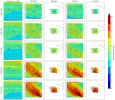
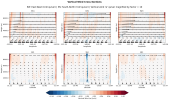
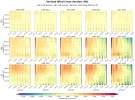
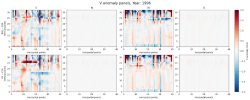
  • Average maps of wind speed/vectors over 5 windows of 5 years each.
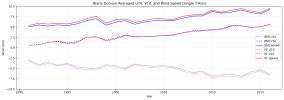
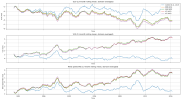
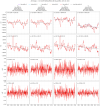
  • Yearly domain-average U10MEAN, V10MEAN and SPDUV10MEAN plots showing the observed shift.
Any insight or advice would be warmly appreciated.

Thank you in advance!

1764527823709.png

1764529568728.png
 
Last edited:
I ran a script to check whether the problem could originate from the original simulation by Dutheil et al., 2019 — as expected, it does not.

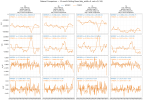
Below, I show a comparison across 5 time windows (rows) for all configurations (BMJ/KF and d01/d02, columns). The shift in wind speed (increase) and direction over the years is clearly visible.

The second figure shows the time series divergence again, while the Dutheil et al., 2019 simulation remains stable over time.

I have also attached my namelist to this post. I am really looking for a way to re-run these long simulations while avoiding this problem.

Thanks again 🙏

1764542218066.png

1764542416714.png
 

Attachments

  • namelist_input.txt
    8.9 KB · Views: 1
Last edited:
This may seem to be due to the internal variability of RCM, but I am not sure because such a small domain should help suppress drift.

If so, Nudging may be a good approach, but I am not sure if NDOWN can generate the data required for FDDA.
 
This may seem to be due to the internal variability of RCM, but I am not sure because such a small domain should help suppress drift.

If so, Nudging may be a good approach, but I am not sure if NDOWN can generate the data required for FDDA.
As the shift grows in time, I wondered about re-initializing the simulation like every 1-3 years. The domaine is quite small and I did not observe spin-up influence though I did discard the first three months of all my runs.
 
I continued to investigate and am now confident that the problem originates from the initialization file.

I ran several experiments with different topography datasets to evaluate their impact. After these tests, I selected one elevation dataset among the five tested. All five topographies were processed using the same NDOWN downscaling technique; however, I only computed long-term boundary conditions for the default elevation dataset.

I compared the wrfinput* files for the default elevation and the selected “best performance” elevation. I found only minor differences for a few variables, which are summarized below:

2D non-zero variables:
ALBBCK, HGT, MUB, PSFC, SST, TMN, TSK, TSLB, VEGFRA

3D non-zero variables:
P, PB, PH, PHB, P_HYD, T, T_INIT

--- 2D variables ---
ALBBCK:
min=-0.009032249450683594
max=0.0
mean=-2.0071665858267806e-05

HGT:
min=-540.2184448242188
max=400.63916015625
mean=-0.016343258321285248

MUB:
min=-4557.8203125
max=6084.7578125
mean=0.08233832567930222

PSFC:
min=-4569.7109375
max=6097.421875
mean=0.08247341215610504

SST:
min=-1.313568115234375
max=10.784881591796875
mean=-0.3489946722984314

TMN:
min=-2.912261962890625
max=3.923858642578125
mean=-0.36336639523506165

TSK:
min=-1.313568115234375
max=10.784881591796875
mean=-0.3489946722984314

TSLB:
min=-2.912261962890625
max=10.784881591796875
mean=-0.35397687554359436

VEGFRA:
min=0.0
max=13.193550109863281
mean=0.029318999499082565


--- 3D variables ---
P:
min=-11.8223876953125
max=16.8546142578125
mean=4.551762685878202e-05

PB:
min=-4553.265625
max=6078.671875
mean=0.04925476014614105

PH:
min=-78.5
max=104.1875
mean=0.0010619120439514518

PHB:
min=-5299.54345703125
max=3930.270263671875
mean=-0.11829734593629837

P_HYD:
min=-4565.0859375
max=6091.2421875
mean=0.04930104315280914

T:
min=-4.474517822265625
max=3.31463623046875
mean=-5.5714845075272024e-05

T_INIT:
min=-4.474517822265625
max=3.31463623046875
mean=-5.5714845075272024e-05

Importantly, there are no differences at all in the wrfbdy* files between these two configurations.

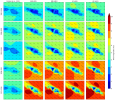
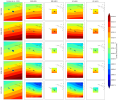
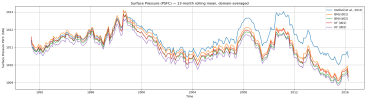
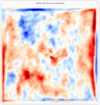
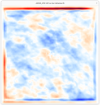
For further insight, I have attached several figures, including:
  • Wind fields (large view)
  • Pressure fields (large view)
  • One grid pressure time series
These may help illustrate the observed discrepancies.

1764623820603.png

1764623706937.png
1764623734791.png
 
For regional climate simulations using WRF, the 'slab' approach usually gives better results than the 'continuous' approach.

'Slab' means that you run WRF with frequent initialization, for example, you run WRF for the summers during a 20-year period, and each WRF run is initialized at the beginning of each individual year.

'Continuous' run means that you iniialize WRF once, and run the model continuously for 20 years.

It is hard to diagnose the reason for large biases in long-term climate simulations of WRF. Too many factors may get involved.
 
For regional climate simulations using WRF, the 'slab' approach usually gives better results than the 'continuous' approach.

'Slab' means that you run WRF with frequent initialization, for example, you run WRF for the summers during a 20-year period, and each WRF run is initialized at the beginning of each individual year.

'Continuous' run means that you iniialize WRF once, and run the model continuously for 20 years.

It is hard to diagnose the reason for large biases in long-term climate simulations of WRF. Too many factors may get involved.
Thank you, Ming.

This was indeed my fallback solution as well—to re-run the simulations in several shorter segments, perhaps reinitializing every 2–3 years. It is a workable approach, though admittedly a bit cumbersome.

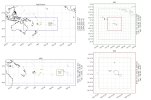
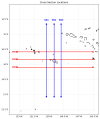
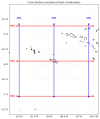
In the meantime, I am still investigating the possible root cause(s) of this drift. Many studies have conducted similar long-term simulations, sometimes over even longer periods (though often at lower resolution), without encountering such issues. In the present case, it seems as though the model is attempting to compensate for spurious forcing at the lateral boundaries. For example, I observe strong updrafts along all boundaries, which—at least to me—suggests that something may have gone wrong quite early in the run. I am also considering whether the LBC generated by NDOWN could be a contributing factor (as shown in the figure below — note that the map encompasses a larger domain than my simulation, but I chose cross-section latitude and longitude ranges that fully cover the model domain).

Lastly, based on your experience, have you encountered similar types of drifts in other work?


1764811816725.png
1764811836169.png
 
Hi, Arty,

Thank you for the detailed description of your results.

Some people in NCAR conducted climate simulations using WRF. As far as I know, they either run single-domain simulations using analysis/reanalysis products as the forcing data, or run multi-domain nested simulations with feedback on. In this way, the results between parent-child domain are more consistent.

The lateral boundary issue shown in your result is not uncommon. We did see such kind of resolution-dependent features in many cases, even in the two-way nested cases. To overcome such issues, we usually recommend to set a large child domain, and exclude results along the boundaries when analyzing the simulations.

Hope this is helpful for you.
 
Top